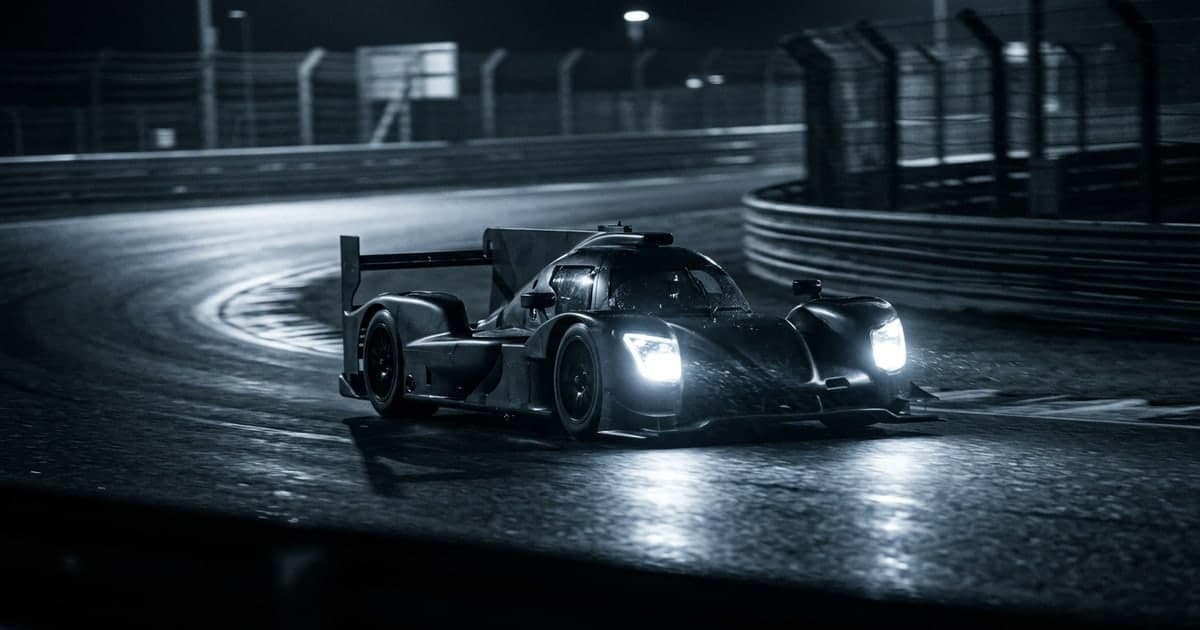
Hour six. The light went an hour ago, you are shooting at ISO 12800 into the braking zone, and you have four thousand frames on the cards. The client wants galleries by morning, split by driver.
Every car on that grid has been on track three times tonight with a different person in the seat.
This is the part of endurance racing that breaks number-first tagging — and it breaks in the opposite direction from every other discipline. The number is not the hard part here. The number is the easy part.
The number is the easy part
A sportscar is built to be read. The competition number sits on a large panel on the door, repeated on the nose and on the roof, sized and lit so that a timing camera can pick it out at speed in the dark. Nothing about it is subtle.
It shows. Across 7,910 cars analyzed under our two endurance profiles, the race number came back on 7,886 of them — 99.7%.
One caveat that applies to every percentage in this piece, starting with that one: we measure how often a field comes back populated, not how often it is right. There is no ground truth behind these figures. So 99.7% means the number was there — not that it was read correctly.
That is about as good as this gets, and it is worth saying what it is not: it is not unique to endurance. Stage rally comes back at 100% in our data and current-spec Formula 1 at 99.8%, for the same reason — big flat panels, designed to be legible. The contrast is with the disciplines where the number is mounted on something that moves. Motocross, where the plate is buried in mud by the second moto and rotates away from the lens on every jump, sits at 89.9%.
So if you shoot sportscars, number recognition is not your bottleneck. Which is exactly the problem, because the number is not what the client is buying.
A number is a car, not a person
A six-hour race has two or three drivers per car. Le Mans has three — the crew is capped there. The number on the door never changes. The person behind it changes every stint.
So tagging by number alone gives you one folder per car with several hundred frames in it, spanning three different drivers, none of whom can be sold a gallery of "their" race. The bronze-rated gentleman driver who paid for the seat wants his stint. The pro who drove the night double wants his. The number cannot separate them, and neither can the car — it looks identical in every frame.
This is why endurance photographers end up hand-sorting by time long after the number problem is solved.
What else comes back from the frame
Beyond the number, the analysis returns a few things worth knowing about, and it is worth being precise about which:
The team. Present on 72.6% of cars. The class — Hypercar, LMP2, GT3 and their series equivalents — on 68.3%. Sponsor text on 61.1%.
That populated-not-verified caveat bites hardest on this last group. Free text read off a wrapped car at racing speed can be a plausible guess rather than a reading. Treat team and class as strong signals to sort on, and sponsor text as a hint.
Manufacturer and livery description come back on about 17% of cars — roughly one in six. That is far better than the near-zero we see in some disciplines, but it is still a minority. Do not build a delivery structure that depends on them.
Where the driver names actually come from
Driver names came back on 67% of the cars in that corpus. That number is real, but on its own it is misleading, because the names are not read off the car. Nothing on a modern prototype reliably identifies who is inside it — the name decal is small, often on the door the camera cannot see, and at night it is invisible.
The names come from the entry list.
The split is about as sharp as data gets. When a car was matched to a loaded entry list — by number, by team, by sponsor, or by our combined matcher — driver names came back on 99.9% to 100% of those cars. When no list match was recorded, they came back on under 8%.
It is close to binary: the list match is the thing that puts a name on the frame. Across our two endurance profiles the driver-name rate was 82% on one and 41% on the other — a spread we are not going to pin on a single cause here, because the two profiles are also tuned differently in the matcher, with different evidence weights and a different threshold for declaring a winner. What is not in doubt is the direction: the frames that carry names are the frames that matched a list.
If you take one operational thing from this: loading the entry list before you process is not a nice-to-have in endurance. It is the single biggest lever you control — the difference between a folder of car numbers and a folder of names — even if it is not the only variable in play. How readily a given car is declared a match is also a matter of how we have tuned the matcher for that series, and that part sits on our side, not yours.
The limit worth knowing before you promise anything
Here is where we have to be straight with you, because it is the thing most likely to bite you on delivery night.
The entry list gives you the car's driver lineup. It does not tell you which of those drivers was in the seat when you pressed the shutter.
We checked what that looks like in practice. Of the cars where the driver field held a single entry, 98.5% of those entries were not one name at all — they were the entire lineup in one string, comma-separated, exactly as the entry list supplied it. You get A. Driver (GBR), B. Driver (FRA), C. Driver (ITA) in a field where you wanted one name.
So what you get is: the car number, the team, the class, and the three people who shared the car. What you do not get is which one. We do not resolve stints, and nothing in the frame would let us: the driver is sealed inside a closed car, behind a helmet, usually in the dark.
Resolving the stint is a timing problem, not a vision problem
The good news is that the missing piece is not visual, so you do not need a camera to solve it. You need a clock.
Every stint has a start and an end, and those are published — in the timing sheets, in the live timing feed, in the team's own pit log. A stint is a time window. Your frames are timestamped by the camera. Intersect the two and the ambiguity disappears.
Which makes one piece of pre-race housekeeping worth more than any amount of sorting later: sync your camera clock to the official race clock before the start, and if you shoot two bodies, sync them to each other. Photographers who skip this spend delivery night trying to reconstruct offsets from pit-stop frames. Photographers who do it can filter a night's shooting into per-driver galleries in a few passes, because the number, the team and the lineup are already on the file.
What this changes on delivery night
The practical shape of an endurance job, then, is two-stage rather than one.
The first stage is automatic and it is fast: every frame carries a car number, and on a shoot with the entry list loaded, a team, a class and a lineup. That is enough to ship per-car and per-team galleries immediately — which covers the teams, the sponsors and the series, and in a lot of jobs is most of the invoice.
The second stage is per-driver, and it is yours: apply the stint windows to the capture times and the lineup collapses to a name. It is a filtering job on data you already have, not a re-sort of four thousand images.
The number was never the hard part in this discipline. Knowing which of the three people who drove that car is in your frame is — and that is a question you answer with the entry list and the clock, not with a better look at the door.